


The original Land Rover Defender, produced from 1983 to 2016, was a masterpiece of mechanical simplicity. With approximately 12 electronic control units managing basic functions, a competent home mechanic with a socket set and a workshop manual could tackle most repairs. The vehicle’s legendary reliability came from its straightforward engineering—what you could see was largely what you got.
The 2020+ Defender L663 represents a complete technological transformation. Beneath its heritage-inspired bodywork lies a rolling supercomputer featuring more than 85 networked electronic control units, automotive ethernet architecture, and sensor systems that would have seemed like science fiction just a decade ago.
For owners who want to understand and maintain their vehicles, this guide breaks down the key technologies that make the L663 one of the most sophisticated off-road vehicles ever built. Whether you’re diagnosing a warning light or planning a service, understanding these systems is the first step toward confident ownership—and exactly why we created our comprehensive Land Rover workshop manual collection.
This guide was featured in TechBullion’s automotive technology coverage.
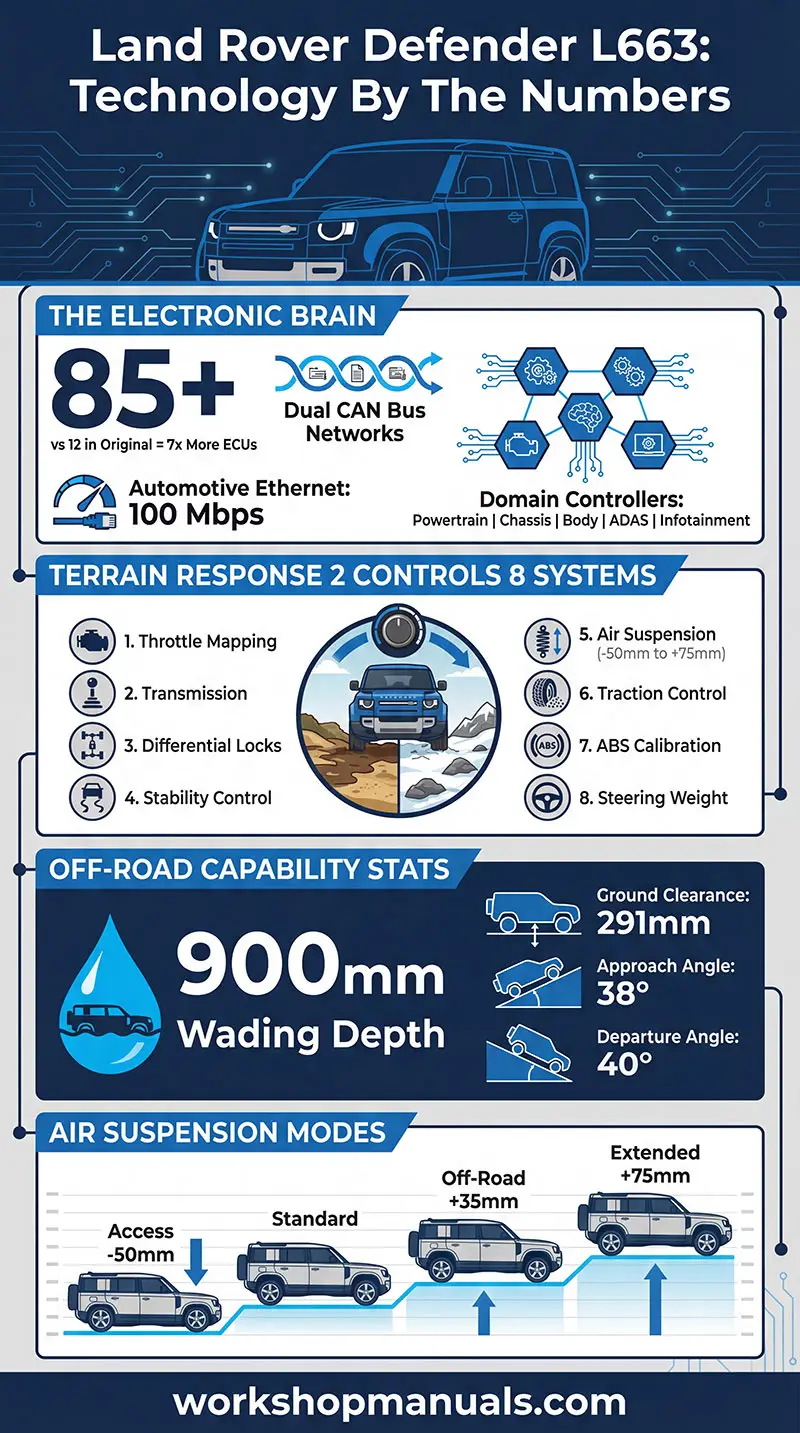
Defender L663 Technology By The Numbers – Save & share this infographic
How Many ECUs Does the 2020+ Defender L663 Have?
The new Defender features more than 85 networked electronic control units—a staggering increase from the original Defender’s dozen or so. These ECUs don’t operate in isolation; they communicate constantly across multiple networks to manage everything from engine performance and transmission behaviour to climate control, terrain response, and advanced driver assistance systems.
The Dual CAN Bus System
The L663 runs dual Controller Area Network (CAN) bus systems operating at different speeds. The high-speed network handles time-critical data like engine management, transmission control, and stability systems—information that must travel in milliseconds. The medium-speed network manages less urgent communications: climate control, lighting, and comfort features.
This separation ensures your air conditioning adjustment never interferes with your anti-lock braking system—a critical safety consideration when you have 85+ modules all trying to communicate.
Automotive Ethernet: First in Class
The L663 was among the first Land Rovers to implement automotive ethernet—a high-bandwidth network capable of transferring data at speeds up to 100 Mbps. This technology was necessary to support the vehicle’s advanced camera systems, which stream high-definition video for features like ClearSight Ground View. Traditional CAN bus simply couldn’t handle this volume of data.
Domain Controller Architecture
Rather than having dozens of independent ECUs each running their own show, the L663 organises its electronic systems into functional domains:
- Powertrain Domain – Engine, transmission, and drivetrain management
- Chassis Domain – Suspension, steering, and braking systems
- Body Domain – Lighting, climate, windows, and locks
- ADAS Domain – Cameras, sensors, and driver assistance features
- Infotainment Domain – Pivi Pro system, connectivity, and entertainment
This architecture improves reliability, simplifies diagnostics, and enables over-the-air software updates that can genuinely enhance vehicle capability long after purchase.
Understanding Your Defender’s Electronics
With 85+ ECUs communicating across multiple networks, proper diagnostic documentation isn’t optional—it’s essential.
What Systems Does Terrain Response 2 Control?
Land Rover’s Terrain Response system has always been a standout feature, but Terrain Response 2 in the L663 elevates the concept to new levels of sophistication. This system doesn’t just adjust one or two parameters—it orchestrates simultaneous changes across eight vehicle systems to optimise performance for any surface condition.
The Eight Systems Under Terrain Response Control
| System | What Changes |
|---|---|
| Throttle Mapping | Pedal sensitivity adjusted for surface grip |
| Transmission | Shift points and torque converter behaviour |
| Differential Locks | Centre and rear differential engagement strategy |
| Stability Control | Intervention thresholds relaxed or tightened |
| Air Suspension | Ride height from -50mm to +75mm |
| Traction Control | Wheel slip allowance calibration |
| ABS Calibration | Braking behaviour for surface conditions |
| Steering Weight | Electric power steering assistance levels |
Auto Mode: Machine Learning on Wheels
Terrain Response 2’s Auto mode uses data from multiple sensors to continuously assess surface conditions and adjust settings in real-time:
- Wheel speed sensors – Detecting slip at each corner
- Steering angle sensor – Understanding driver intent
- Yaw rate sensor – Measuring vehicle rotation
- Accelerometers – Sensing pitch and roll
- Suspension position sensors – Detecting load distribution
This sensor fusion allows the vehicle to respond to changing conditions faster than any human could select the appropriate mode manually. Understanding how these sensors communicate—and what happens when one fails—is covered in detail in the Defender L663 workshop manual’s diagnostic section.
Wade Sensing: Intelligence in Depth
One of the L663’s most impressive technologies is its wade sensing system. Ultrasonic sensors mounted in the door mirrors continuously measure water depth as the vehicle enters a crossing, displaying real-time depth information on the touchscreen. With a maximum wading depth of 900mm (nearly three feet), the Defender can tackle water obstacles that would stop most vehicles—but it does so with the confidence of knowing exactly how deep the water is at any moment.
What is ClearSight Ground View Technology?
The L663’s camera systems go far beyond parking assistance. Land Rover’s ClearSight technology suite represents some of the most advanced visual systems available in any production vehicle.
ClearSight Ground View
Perhaps the most remarkable feature is ClearSight Ground View, which creates a virtual “transparent bonnet” by stitching together feeds from multiple cameras:
- A forward-facing camera mounted beneath the grille captures the ground directly ahead
- Cameras in the door mirrors provide peripheral coverage
- Advanced image processing combines these feeds in real-time
The result displays what appears to be a view through the bonnet itself. For off-road driving, this means seeing exactly where your front wheels are about to go—invaluable when navigating rocky terrain or tight trails where wheel placement is critical.
3D Surround Camera System
The 360-degree surround view system uses four or more cameras to create a bird’s-eye view of the vehicle and its surroundings. What sets the L663’s implementation apart is its 3D capability—the system can render the vehicle from multiple virtual viewpoints, allowing drivers to “walk around” their Defender digitally to spot obstacles or assess parking situations.
ClearSight Rear View Mirror
The digital rear-view mirror uses a roof-mounted camera to provide an unobstructed view behind the vehicle, regardless of passengers, cargo, or the spare wheel mounted on the tailgate. HDR processing ensures clear visibility from bright sunlight to dark tunnels.
Technical consideration: These camera systems require precise calibration to function correctly. A windscreen replacement, for example, may require camera recalibration—a procedure that demands specific equipment and technical knowledge documented in the factory workshop manual.
Electronic Air Suspension: The Foundation of Capability
The L663’s electronic air suspension (EAS) system is central to both its on-road refinement and off-road capability. This system continuously manages ride height, load leveling, and damping to optimise performance across every driving condition.
System Components
The EAS comprises several key components working together:
- Air compressor – Generates and stores pressurised air
- Air reservoir – Tank for compressed air storage
- Four height sensors – One at each corner monitoring ride height
- Four air springs – Replacing conventional coil springs
- Valve block – Controls air distribution to each corner
- EAS control module – The brain coordinating all operations
Height Modes
| Mode | Height Change | Use Case |
|---|---|---|
| Access Mode | -50mm | Easier entry and exit |
| Standard | Normal | On-road driving |
| Off-Road | +35mm | Light off-road terrain |
| Off-Road Extended | +75mm | Maximum ground clearance |
The system also automatically lowers the vehicle at motorway speeds for improved aerodynamics and fuel efficiency, then returns to standard height when speed decreases.
💡 Common Diagnostic Scenario: Air Suspension Fault
An “Air Suspension Fault” message might indicate anything from a slow leak in one air spring to a failing compressor to a miscalibrated height sensor. Proper diagnostic documentation helps owners work through a logical sequence—checking for obvious leaks, verifying sensor readings, testing compressor operation—before assuming worst-case scenarios. Often the culprit is a slow leak at an air line connection or a height sensor knocked out of calibration by off-road use.
Why Proper Documentation Matters More Than Ever
The technological sophistication of the L663 has fundamentally changed what it means to be a knowledgeable vehicle owner. With the original Defender, mechanical aptitude and a basic workshop manual were sufficient for most maintenance and repair tasks. The new Defender adds another dimension: electrical and electronic understanding.
The Documentation Gap
Generic repair information—the kind available in consumer-focused repair guides—provides only surface-level coverage of vehicles like the L663. These resources might explain how to change oil or replace brake pads, but they rarely include:
- Wiring diagrams showing ECU locations and connector pinouts
- Diagnostic trouble code definitions specific to JLR systems
- Calibration procedures required after replacing certain components
- Service mode procedures for electronic systems like the parking brake
Real-World Examples
Scenario 1: Brake Pad Replacement
Even seemingly simple tasks have electronic dimensions on the L663. The electric parking brake must be placed into service mode before rear brake pad replacement—a procedure requiring specific steps through the vehicle’s diagnostic system. Attempting the job without this knowledge risks damaging parking brake actuators.
Scenario 2: Terrain Response Warning
After an off-road excursion, the Terrain Response system displays limited functionality. Generic code readers show multiple fault codes across different systems. Factory documentation explains how Terrain Response integrates data from wheel speed sensors, steering angle sensors, and the transfer case—and crucially, which sensor correlates to which fault code pattern.
Scenario 3: Camera Calibration
After windscreen replacement, the ClearSight Ground View isn’t displaying correctly. This requires camera recalibration—a procedure documented in the workshop manual but not available in generic repair guides.
Get Complete Defender L663 Workshop Documentation
Factory-specification procedures • Wiring diagrams • Diagnostic codes • Calibration steps
Everything you need to understand, diagnose, and maintain your Defender
The Bottom Line
The 2020+ Land Rover Defender L663 proves that rugged capability and cutting-edge technology aren’t mutually exclusive. This vehicle can wade through water nearly a metre deep, climb grades that would defeat most vehicles, and traverse terrain that seems impossible—all while its 85+ ECUs monitor, adjust, and optimise every system in real-time.
For owners, this sophistication presents both challenges and opportunities. The complexity can seem intimidating, potentially pushing all maintenance into dealer hands. Or, with the right information and understanding, it can be embraced—adding a new dimension to vehicle ownership that’s as rewarding as mastering the mechanical systems of older vehicles.
The key lies in documentation. Just as a previous generation of Defender owners kept dog-eared workshop manuals in their garages, today’s L663 owners benefit from comprehensive technical information that explains not just what to do, but how the vehicle’s sophisticated systems work together.
Frequently Asked Questions
How many ECUs does the 2020+ Defender L663 have?
The 2020+ Land Rover Defender L663 features more than 85 networked electronic control units (ECUs), compared to approximately 12 in the original Defender. These ECUs communicate across dual CAN bus networks and automotive ethernet to manage all vehicle systems.
What systems does Terrain Response 2 control?
Terrain Response 2 simultaneously controls eight vehicle systems: throttle mapping, transmission shift points, differential lock engagement, stability control thresholds, air suspension height, traction control sensitivity, ABS calibration, and steering weight.
What is the maximum wading depth of the Defender L663?
The Defender L663 has a maximum wading depth of 900mm (approximately 35 inches or nearly 3 feet). The vehicle’s wade sensing system uses ultrasonic sensors in the door mirrors to display real-time water depth on the touchscreen.
What is ClearSight Ground View?
ClearSight Ground View is a camera system that creates a virtual “transparent bonnet” view by combining feeds from a camera beneath the grille and door mirror cameras. This allows drivers to see the ground directly beneath and ahead of the front wheels—essential for precise wheel placement off-road.
Can I service my Defender L663 myself?
Yes, many maintenance and repair tasks can be performed by owners with proper documentation. However, the L663’s electronic systems often require specific procedures (like putting the electric parking brake into service mode for brake pad replacement) that are only documented in factory workshop manuals. Our Defender L663 service manual includes these procedures.
What air suspension height modes does the Defender L663 have?
The Defender L663 offers four height modes: Access mode (-50mm for easier entry), Standard height for normal driving, Off-Road height (+35mm), and Off-Road Extended (+75mm for maximum ground clearance).
Related Land Rover Workshop Manuals
If you’re interested in Land Rover technical documentation, you may also find these manuals useful:
- Range Rover L405 (2013-2022) Workshop Manual – Shares many systems with the L663
- Land Rover Discovery 5 L462 Workshop Manual – Similar PLA architecture
- Range Rover Sport L494 Workshop Manual – Related JLR platform documentation